Required Reading Level for the Validity Indicator Profile
Definition
Volume Contour is an avant-garde charting study that displays trading activity over a specified time menstruation at specified toll levels. The study (accounting for user defined parameters such equally number of rows and time period) plots a histogram on the chart meant to reveal dominant and/or significant price levels based on volume. Substantially, Book Profile takes the total volume traded at a specific cost level during the specified time period and divides the total book into either buy book or sell volume and so makes that data easily visible to the trader.
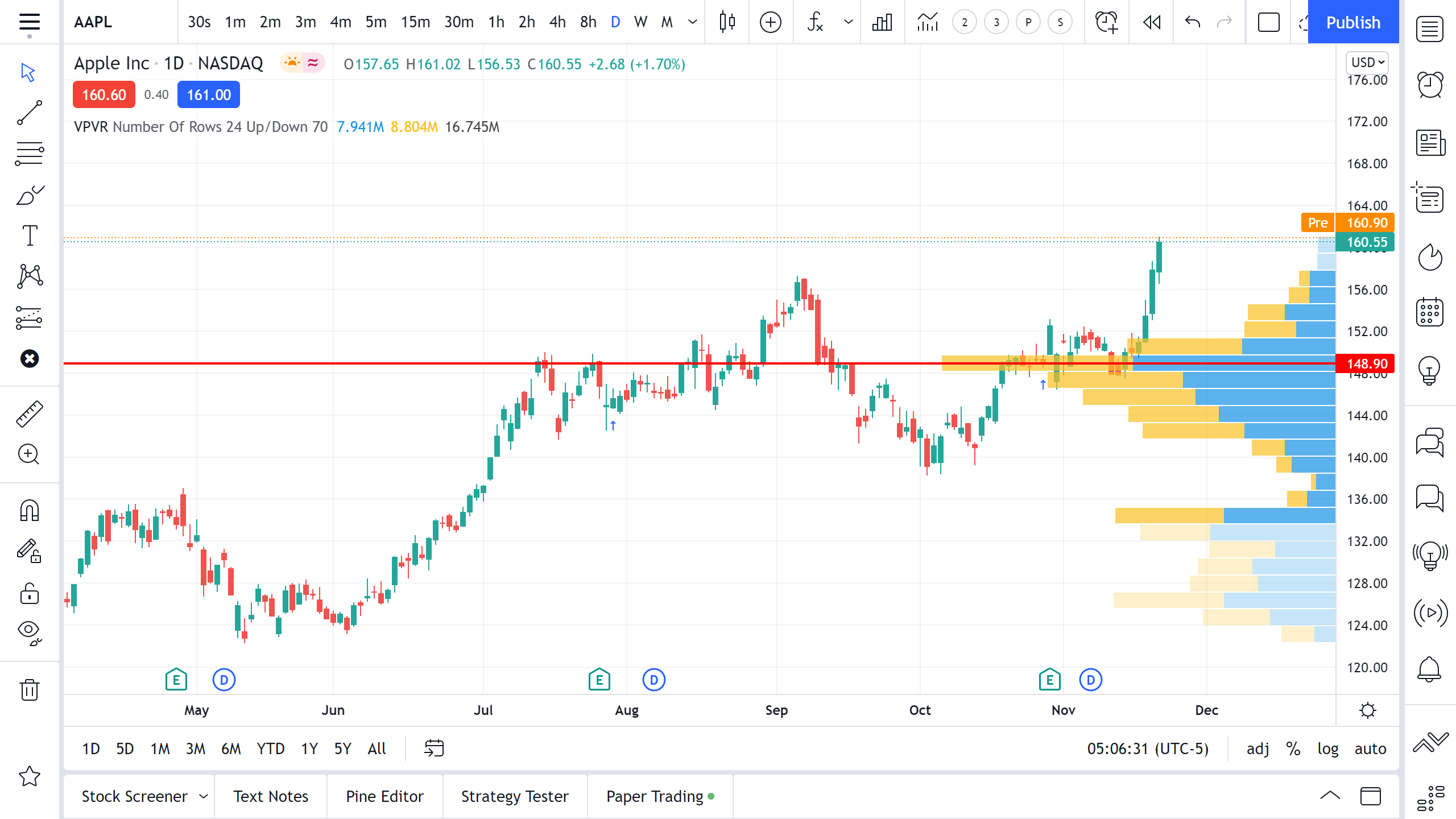
Typical levels of significance
- Signal of Control (POC) – The price level for the time catamenia with the highest traded book.
- Profile High – The highest reached price level during the specified time period.
- Profile Low – The everyman reached cost level during the specified time menses.
- Value Area (VA) – The range of price levels in which a specified percent of all volume was traded during the time period. Typically, this percentage is set to 70% however it is upwardly to the trader's discretion.
- Value Expanse High (VAH) – The highest price level within the value area.
- Value Expanse Low (VAL)– The lowest price level within the value area.
Calculation
How to Summate Value Area (VA)
- Decide the total book traded in the profile (total buys and sells).
- Take the number of total buys and sells and multiply it by .7 to make up one's mind what number is lxx percent of the total buys and sells. (70% is a typical example however any percentage tin can be used by the trader).
- Get-go at the POC (The row in the contour with the greatest total volume) and record its total book number. The POC will exist the starting time profile row added to the Value Surface area.
- Now look at the ii rows in a higher place the POC (the initial value surface area) and add the total volume of both.
- Now look at the two rows beneath the POC (the initial value area) and add the total volume of both.
- Decide which of the total volume numbers is larger and add it to the total volume number of the POC institute in pace 3.
- Repeat steps iv and five adding the larger of the 2 numbers to the Value Area.
- Once the full book of your Value Area matches or slightly surpasses the number found in step 2, the Value Area has been determined.
- The highest row within the Value Area will be your Value Area High (VAH) and the everyman row within the Value Area will be your Value Expanse Low (VAL).
Depending on a fourth dimension resolution of a chart, data from various resolutions can be used in calculations of Book Profile. When calculating Stock-still Range and Visible Range, we alternately try resolutions from 1, 3, 5, fifteen, xxx, 60, 240, 1D, until the number of confined in the fourth dimension interval, for which VP is calculated, volition be less than 5000. For Session Volume the post-obit dependency on a chart resolution is adopted:
| Chart resolution | Resolution of bars used for VP calculation |
| ane - 5 | i |
| half-dozen - xv | five |
| 16 - 30 | 10 |
| 31 - sixty | xv |
| 61 - 120 | 30 |
| 121 - 1D | lx |
What to wait for
Back up and Resistance Levels
The first thing that most traders will use volume profile for is identifying bones support and resistance levels. It is of import to note that using Book Profile as an identifier for support and resistance levels is a reactive method. This means that different proactive methods (such every bit trend lines and moving averages) which are based on current toll action and analysis to predict future price movements, reactive methods rely on past cost movements and volume beliefs. Reactive methods can be useful in applying meaning or significance to price levels where the market place has already visited. Basic technical analysis has shown that a support level is a price level which volition back up a cost on its mode down and a resistance level is a price level which will resist cost on its way up. Therefore, one can conclude that a toll level nigh the bottom of the profile which heavily favors the purchase side in terms of volume is a good indication of a support level. The opposite is also truthful. A price level virtually the top of the profile which heavily favors sell side volume is a proficient indication of a resistance level.
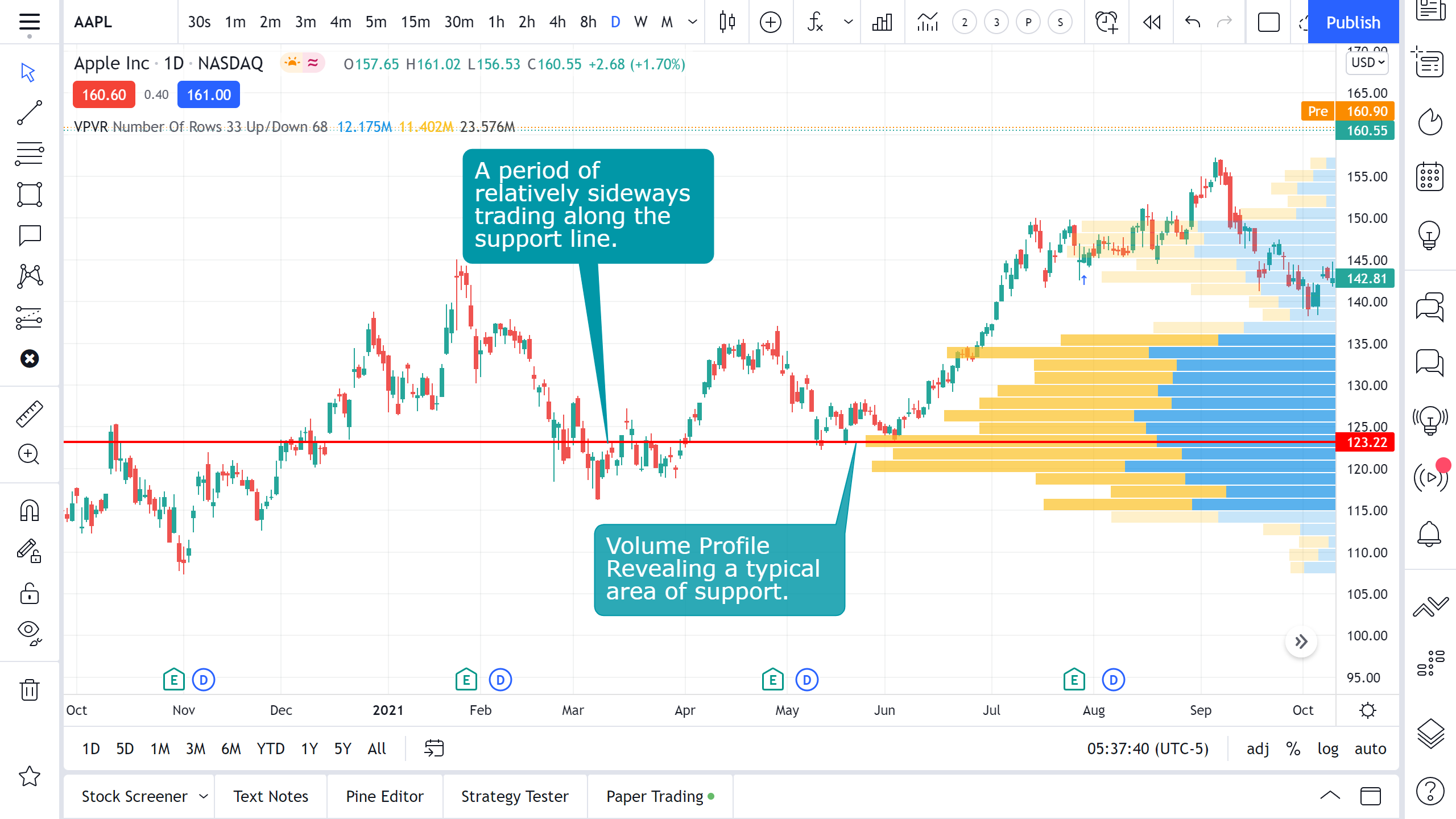
Book Nodes
High Book Nodes (HVN) are peaks in volume at or around a price level. HVN can be seen as an indicator of a period of consolidation. Usually there is a not bad deal of activity on both the buy and sell side and the marketplace stays at that price level for a great deal of fourth dimension compared to other levels in the profile. This can imply a "fair value area" for the asset. When toll approaches a previous HVN (or off-white value area) a sustained period of sideways movement is expected. The market is less likely immediately break through that price.
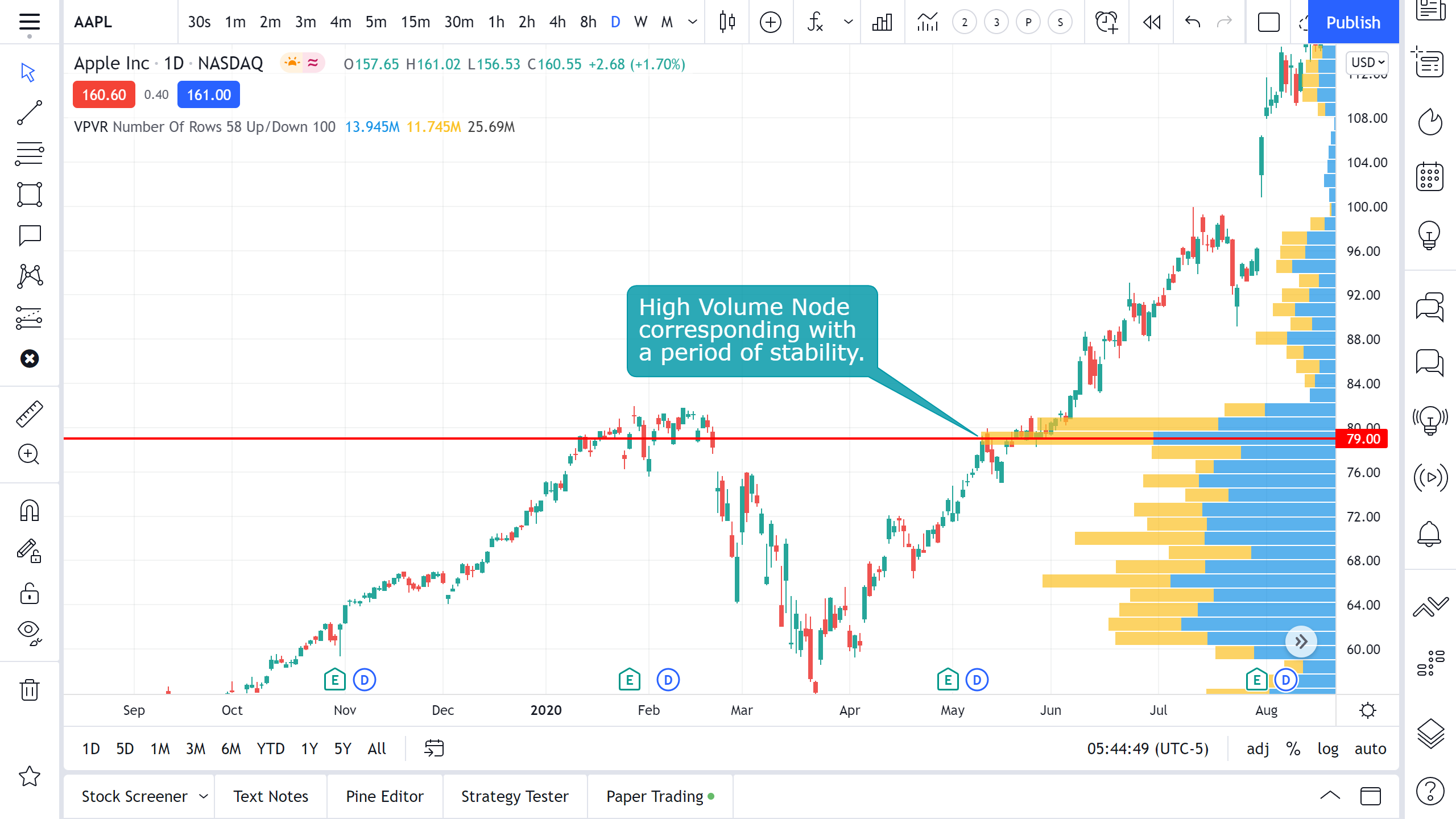
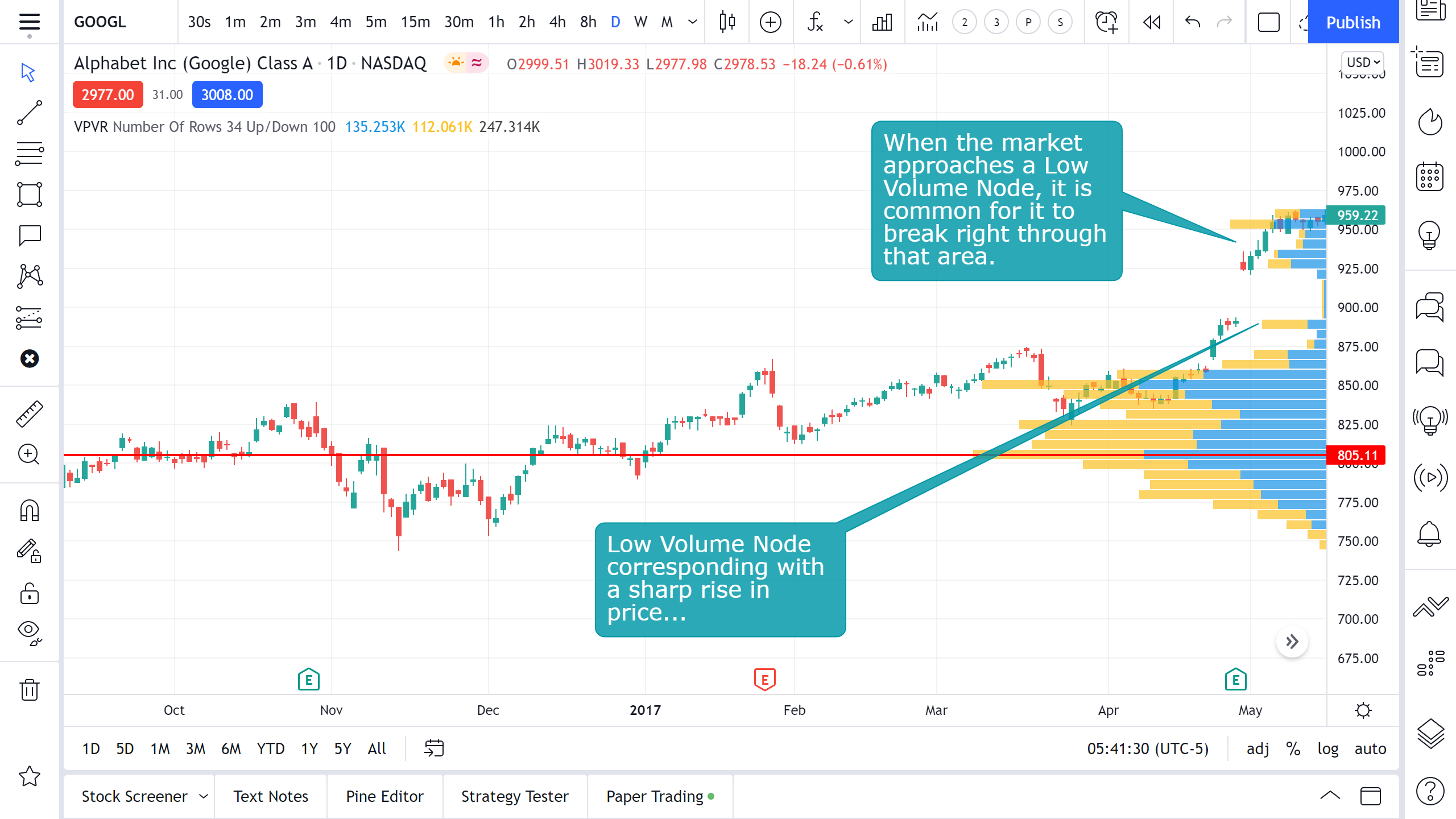
Depression Volume Nodes (LVN) are the reverse. They are valleys (or significant drops) in volume at or around a price level. Low Volume Nodes are commonly a result of a breakout rally or a breakdown. During a rally or a breakdown, there will typically exist an initial burst of volume so a significant drib off. The drop off can imply an "unfair value area" for the asset. When toll approaches a previous LVN (or unfair value expanse), the market is much more than likely to rally through or bounce off of that price level. Because it is seen every bit an unfair value area, the market volition not spend as much fourth dimension there compared to some other levels in the profile.
Example strategy
Just like with nearly other tools or studies, Book Profile has a number of uses. At that place are many trading strategies out there using Volume Profile every bit a key component. Below are the basics of ane such strategy which is based on comparing the electric current day's opening cost to the previous solar day's Volume Contour.
- If the current day opens above the previous solar day's value area (merely still below the Profile Loftier) look for price to retrace dorsum towards the Indicate of Control and then go on to rise (the direction of the day's open up). Therefore during the retracement to the Indicate of Control, there is a buying opportunity.
- If the current day opens below the previous day's value surface area (just yet above the Profile Low) look for price to retrace dorsum towards the Point of Control and so proceed to fall (the management of the day's open up). Therefore during the retracement to the Indicate of Command, there is a selling opportunity.
- If the current day'southward opening toll is completely outside of the previous 24-hour interval's profile (above the Profile High or below the Contour Depression) this can be seen equally a possible runner in the direction of the opening toll relative to the previous day'due south contour range.
Summary
Volume Profile is an extremely valuable technical analysis tool that is used by traders everywhere. The central to Book Profile's continued relevancy is its versatility. Information technology is a charting tool that truly does take a wide array of uses. Unlike many other studies, there is picayune to no argue nearly Book Profile's usefulness. The information that is provided past Book Contour is indisputable, leaving it to the trader to observe new and creative ways to employ it. Even though in its simplest form, it is a great reactive method for discovering traditional back up and resistance areas, traders are still coming upwards with ways to chart the indicator in predicative or proactive means. Consider the trading strategy example given earlier in the article. Being able to compare a existent-time event (the current day's open) with historical events (the previous day'south book contour) and make a trading decision based on the relationship is a bully example of this.
Inputs

Rows Layout
Number of Rows lets you set a specific number of rows that the indicator will display. The Ticks Per Row setting establishes how many minimum ticks should be in every row.
Row Size
The number of rows to be calculated and shown.
Volume
Toggles betwixt showing total volume for each row or splitting each row into buys and sells.
Value Area Volume
Sets the range of cost levels in which a specified percentage of all book was traded during the time period (lxx% by default).
Style

Volume Profile
Toggles the visibility of the indicator.
Bear witness Values
Toggles the display of the numerical values on the indicator itself (buy/sell or full, depending on the 'Volume' setting in the Inputs)
Width (% of the Box)
Alters the width of the rows.
Placement
Identify rows either left or right.
Text Color
Determines the text color.
Up Volume
Determines the color every bit well equally opacity for the Up Volume (Buys).
Down Volume
Determines the color as well equally opacity for the Down Volume (Sells).
Value Area Upwards
Determines the color as well as opacity for the Value Area Up.
Value Area Down
Determines the colour every bit well as opacity for the Value Expanse Down.
POC
Toggles the visibility of the Point of Control.
Developing POC
Toggles the visibility of the Developing Point of Command, showing you how POC was changing when the market was in session.
Developing VA
Toggles the visibility of the Developing Value Area, showing you how VA was changing when the market place was in session.
Source: https://www.tradingview.com/support/solutions/43000502040-volume-profile/
0 Response to "Required Reading Level for the Validity Indicator Profile"
Post a Comment