Act Allowing Farmers and Confederates to Vote Again
Until recently, Department iii of the 14th Amendment was an obscure part of the U.S. Constitution.
The amendment is better known for its commencement section, which guaranteed individual rights and equality post-obit the abolition of slavery. Section 3 of the 14th Amendment was created to tackle a different trouble related to the Civil War: coup.
It prohibits current or one-time military officers, along with many electric current and old federal and state public officials, from serving in a diversity of government offices if they "shall have engaged in coup or rebellion" confronting the U.s.a. Constitution.
This department was created after the Ceremonious War as part of the 14th Subpoena to bar military officers and ceremonious officials who joined the Confederacy from serving in government again.
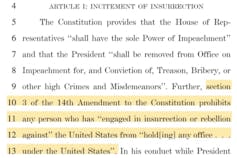
Now, this provision is cited in the article of impeachment confronting erstwhile U.S. President Donald Trump, introduced after the insurrectionist violence at the Capitol on January. half dozen, 2021. An impeachment trial is began in the Senate on Feb. 9. If Trump is acquitted, some senators have reportedly considered a resolution invoking Section 3 of the 14th subpoena in an effort to bar him from belongings future office.
A Reconstruction-era amendment
Correct after the passage of the 14th Subpoena in 1868, Department 3 was enforced vigorously.
For example, Congress directed the Wedlock Army to oust any old Confederate officials and then holding office in the ex-Confederate states still under martial police force. It is estimated that tens of thousands of men were made ineligible to serve by Section iii.
Congress then enacted legislation equally part of the First Ku Klux Klan Act in 1870 giving the Justice Department say-so to bring lawsuits in federal court to enforce Section 3 against former Confederate officials withal property part in other states.
Iii justices on Tennessee's Supreme Court were sued nether this police. One resigned; the other 2 contested their ineligibility in court. Northward Carolina and Louisiana also enforced Section 3 in courtroom upholding in 1869 the dismissal of some country officials who had served the Confederacy, including a sheriff, a lawman and a district chaser.
In 1871, after the North Carolina Legislature elected their Ceremonious War-era governor, Zebulon Vance, to the Senate, the Senate deemed him ineligible to serve under Department 3. The state legislature was forced to cull someone else.
Unity versus accountability
Less than five years into Reconstruction, nevertheless, many Northerners began calling on Congress to grant amnesty to Southern officers barred from part by Section 3. The 14th Amendment gives Congress the power to restore the right to agree part with a two-thirds vote in each chamber.
This campaign, led past the prominent New York newspaper editor Horace Greeley, reflected white fatigue with the burdens of enforcing the entire 14th Subpoena and a want to move past the bitterness of the Civil State of war. Greeley and his "Liberal Republicans" mounted a presidential campaign in 1872 based in part on a platform of "universal amnesty."
President Ulysses Southward. Grant, who was running for reelection, knew white public stance now favored amnesty. In a December. 4, 1871 message to Congress, he asked lawmakers to grant amnesty to former Confederate officials. After a long and emotional contend, Congress did so in 1872 with the General Amnesty Act.
Soon Southern voters sent many previously butterfingers men back to Congress, including Alexander Stephens, the sometime Confederate vice president.
Confederate president Jefferson Davis and a few hundred other one-time federal officials and military officers remained excluded from public office.
In granting this amnesty, Congress rejected a proposal by Massachusetts Sen. Charles Sumner, an eloquent abet for racial equality, to couple forgiveness for white Southerners with a new civil rights law that would, among other things, take barred racial discrimination in schools.
In 1898, with the Castilian-American War about to begin, Congress removed Section 3 ineligibility from all living ex-rebels. It was widely seen as another gesture of national unity, but it was another nail in the coffin of Reconstruction.
Neglected but not forgotten
During the 20th century, Department three was largely ignored. It was used just once, during World War I, to exclude the socialist Congressman Victor Berger from the Firm for his anti-war speeches.
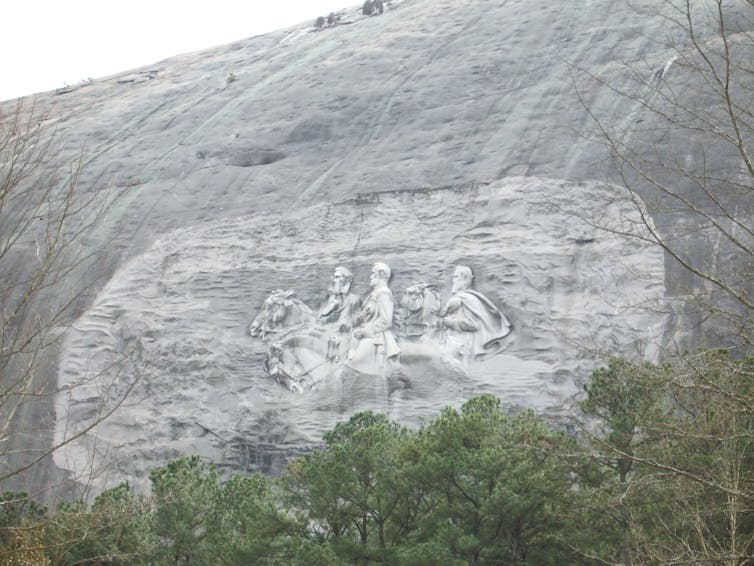
In the 1970s, Congress gave Robert East. Lee and Jefferson Davis posthumous Section iii amnesty. This was again done in the name of national "reconciliation," subsequently the divisive Vietnam War.
Today Department iii, created to vanquish white supremacy, is seeing a revival. The Confederate flag, which never entered the Capitol during the Civil War, was carried inside during the Jan. 6 Capitol coup.
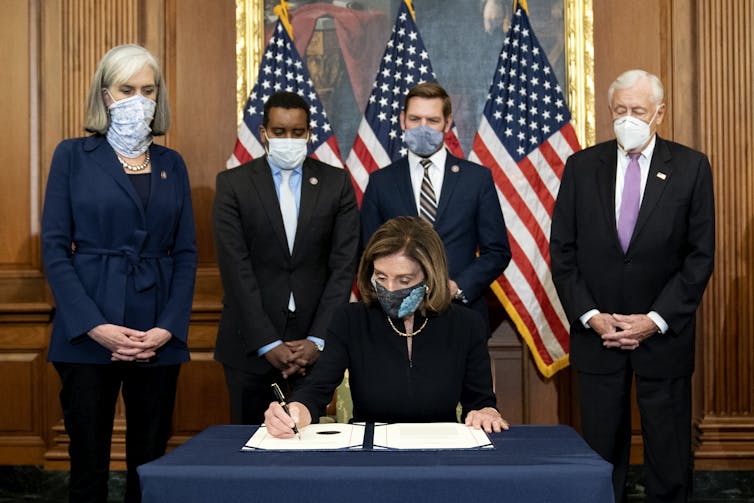
Any congressional members adamant to have "engaged in insurrection" may be expelled under this provision by a two-thirds vote in their business firm of Congress. That includes, potentially, lawmakers who are establish to have direct aided or incited the rioters. Capitol police are investigating several Republican congressional representatives for allegedly leading "reconaissance" tours of the building on Jan. 5.
Though lawmakers can remove their colleagues from office, they cannot legally keep those members from running for, and occupying, public role again. That's because there is today no federal statute enforcing Section 3; those parts of the Ku Klux Klan Act were repealed long agone. Unless Congress passes a new enforcement law, whatever expelled lawmakers could return after.
[Deep cognition, daily. Sign up for The Conversation's newsletter.]
Similarly, Congress could at any time employ Section 3 to declare its ramble opinion that Trump is ineligible to hold public office once more, with a bulk vote. But merely the courts, interpreting Section 3 for themselves, tin can bar someone from running for president.
The issue may never come up. The Senate may disqualify Trump first, every bit part of impeachment, or he may choose not to run over again. If he does run, though, he may have to take his example to the Supreme Courtroom. A bipartisan congressional opinion of ineligibility would be a large blow to his candidacy.
This article, originally published January. 29, 2021, has been updated to reflect latest developments.
Source: https://theconversation.com/congress-could-use-an-arcane-section-of-the-14th-amendment-to-hold-trump-accountable-for-capitol-attack-153344
0 Response to "Act Allowing Farmers and Confederates to Vote Again"
Post a Comment